Rethinking Real Estate (Palgrave Macmillan, 2020) is an excellent book.
It is not “an excellent book about real estate”, it is an excellent book full stop.
Packed with informative nuggets about history, disruption, social change, venture capital and, yes, real estate, it is an enjoyable and informative read.
The author, Dror Poleg is an advisor to some of the world’s largest investors, educating them on the impact of technology on real estate. He has also developed real estate himself. Applying highly academic research to his real-life experience results in this “playbook” for the future of real estate, providing thoroughly practical advice.
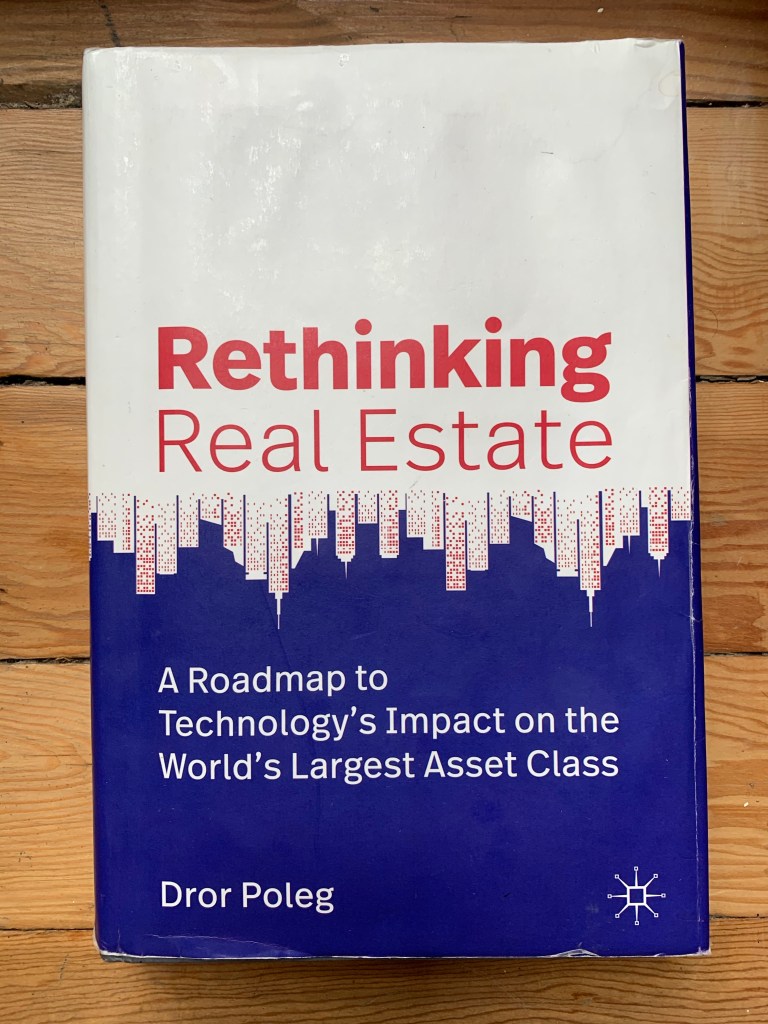
Rather than try to “review” the whole book I have explored one of the themes I found most compelling.
This is the idea that technology is decreasing scarcity of land and increasing scarcity of human connection.
Scarcities are switching: Land is no longer scarce, human connection is.
This is a big sentence given that the theory of scarcity of land has underpinned real estate economics for ever. The logic was: land is the one thing that cannot be produced, therefore once you own land, you are in a monopoly position.
Whilst land still cannot be produced, technology makes our occupation of land more efficient. We use less space, only when we need it, decreasing our overall demand.
Simultaneously, supply has effectively been increased as one space can be used for multiple purposes in one day. Take, for example, The Skygarden at the Walkie Talkie. This starts the day as a sunrise yoga studio, becomes a cafe, then a restaurant, ending the day as a late-night music venue.
These activities could take place in four different locations but with booking systems and data tracking what people want and when they want it, The Skygarden can adapt throughout the day, generating income around the clock.
In contrast, as technology has effectively made land more abundant, it has made high-quality, human connection more scarce.
Given that we can function adequately from a single space with a laptop, order anything we need to our door and not leave the house, we have far fewer high-quality interactions with people.
Covid-19 provides a good case study. Zoom calls do a good job of connecting with friends & colleagues we already know but could we have forged those relationships without interacting face-to-face? We could, but it would take longer, be more deliberate and miss serendiptous interactions.
These changes are intimidating for the traditional landlord but provide wonderful opportunities for a forward-thinking landlord.
How To Embrace These Changes
Offices
Nowadays, to calculate all the “office” space we should include all places a person can conduct professional work. With a mobile phone and laptop, this is theoretically limitless, including (but not confined to) traditional offices, co-working offices, hotel lobbies, cafes, spare rooms, airport lounges, park benches and so on.
As Poleg states, these spaces are “serving the office needs of some workers, some of time”, he notes:
“The office of the future is not a single location; it is a network of spaces and services. Tenants don’t want “space”; they want a productivity solution.”
(Poleg, 2020, pp.98).
To stay useful to our occupiers we need to provide services enabling them to achieve their best work. This means providing access to high-quality spaces to perform different elements of the working day. This doesn’t mean you have to own a whole network to provide an office solution. It could come through operational partnerships or reciprocal agreements with other landlords.
The key is switching the mentality from landlords being “space providers” to being businesses who enable their occupiers to undertake their best work.
Sometimes this will be in a traditional office, sometimes in a shared auditorium, sometimes a cafe and, yes, sometimes it will be in their own homes.
Retail
“Technology questions whether retail spaces should exist at all…physical retail emerged to solve a set of temporary problems..technology reduces or eliminates these costs”
(Poleg, 2020 p. 53)
Poleg provides a detailed and fascinating explanation of why retail transformed in the past and why it’s changing now.
Retail as we know it evolved to solve three specific problems:
- Triangulation – buyers finding sellers
- Transfer – swapping of goods and payment
- Trust – confidence both parties honour their side in the deal
(Poleg, 2020, p.20)
The internet has removed all of these problems: we can buy anything, from anywhere in the world (triangulation), pay for it via Paypal or Stripe (transfer) and review & return (trust).
This explains why many generic high-street shops fell prey to the internet (even pre-CV19). But there is a new phenomenon it does not explain – the trend for online retailers moving offline.
Amazon are taking physical stores, where you can pick something off the shelf, walk out and it is charged straight to your Amazon account1.
More surprisingly, smaller brands are also moving offline. Take the following:
- Rapha (cycling kit)
- Veja (trainers)
- Away Travel (suitcases)
- Harry’s (razors)
- Eve (mattresses)
- Glossier (make-up)
- GymShark (gym kit)
These all started online and now have physical (and global) retail presence. Known as Digitally Native Vertical Brands (DNVBs), these are the ones to watch. They will be the ones populating our retail spaces in the future.
These brands are moving offline to further the relationships developed with customers on social media and to provide curation and personal advice. Internet shopping can leave us paralysed by choice. We avoid this overwhelm when a real human tells us “you should buy this one because it will solve your specific problem”. As Poleg states:
“In a world of abundance, curation becomes more valuable than ever.”
(Poleg, 2020, p.33)
Retailers who curate these offline experiences, with deep human connection will be the ones who thrive. In turn, the landlords who enable retailers to do this, will thrive. This means landlords need to understand their local demographic, interact with appropriate DNVBs and enable them to translate into the physical world with as little friction as possible.
In conclusion, landlords have an exciting opportunity to provide adaptable places, with a higher level of service, facilitating better human connections. Those who grab this opportunity will thrive, creating excellent places where people are drawn to spend their time and money.
This is just one of many compelling themes in Rethinking Real Estate which resonated with me. If you’re in the world of real estate you will find many more valuable lessons within its pages.

 People | Spaces | Places