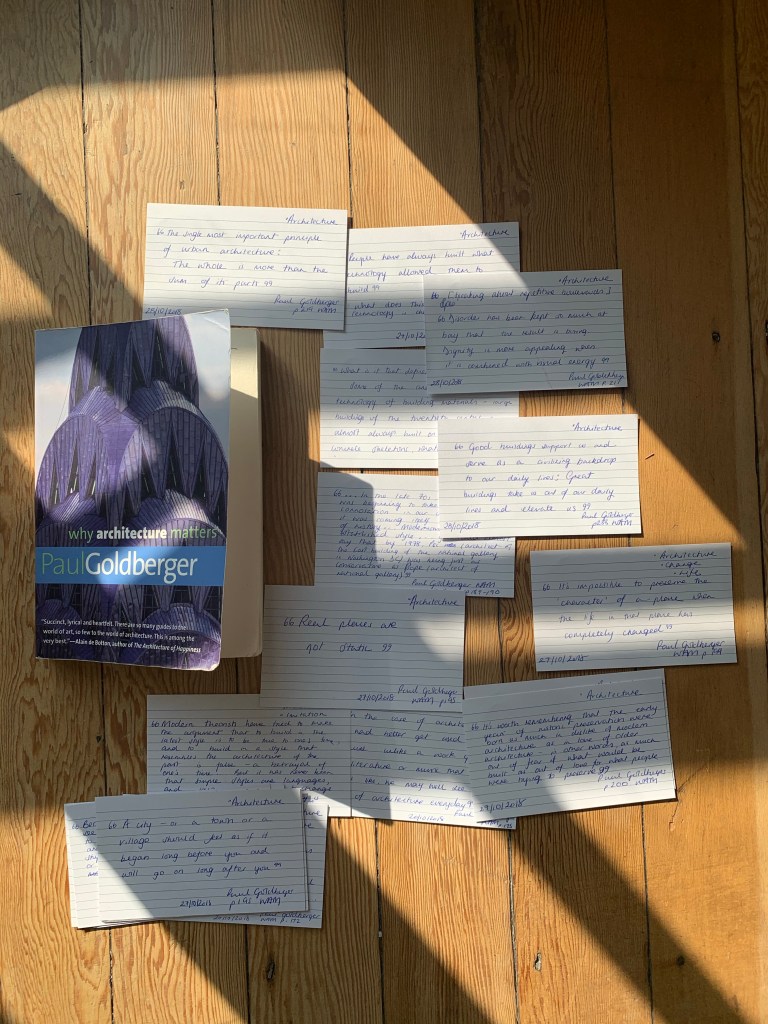
An Enthusiastic Recommendation
Paul Goldberger articulates many things that I intrinsically believe about architecture but do not have the words to express.
Despite its title, Goldberger does not assume that architecture does matter, he does not take it too seriously. He recognises that good architecture has the power to uplift but has its limitations:
Q// I have no desire to claim that architecture can save the world. Great architecture is not bread on the table. It affects the quality of life, yes, and often with an astonishing degree of power…but it does not heal the sick or teach the ignorant…at its best it can help to heal and to teach by creating a comfortable and uplifting environment for these things to take place in.//
By facing this head on, Goldberger frees himself to talk about the aspects of architecture that can matter.
This is key for anyone working in the built environment to consider. When creating and shaping places we need to understand how they sit in the context of place and time. Otherwise we risk building one-dimensional places that will not last.
This book is full of insightful gems but three main themes that resonated for me were change, technological context and our daily interaction with architecture. Below I explore Goldberger’s approach to each.
Change
Throughout the book, Goldberger reminds us that, as change is constant in life, it is constant in architecture:
Q// The first reason that buildings change over time is that we change //
and
Q// Real places are not static //
We often critique demolition or refurbishment of buildings whilst forgetting that this normally happens because its previous use has become inappropriate for the way we live now.
Take the typical Victorian terraced house. They were built with a number of small distinct rooms as this was appropriate for the time. Now, in a huge number of those houses, those rooms have been knocked together to create the large open-plan kitchen/living room/dining room arrangement that suits how we live today.
The one thing we know for certain is that things change. Therefore, as we change and our needs change, our buildings will change.
We are better off building places that can be resilient and withstand that change. Hence the famous philosophy of good architecture “long life, loose fit”.
Technological Context
Q// People have always built what technology allowed them to build…as technology advances, architecture responds to the potential it offers, as it has since the beginning of buildings.//
This begs the question: what can we build today with our technology that we could not in previous times? This is fascinating and exciting. Unlike in previous technological periods I don’t think today’s technology will change the look of buildings as much as it will change the intelligence of buildings.
There is a degree of public consensus of the way a building should look. This is evidenced by the number of mass UK housebuilders building visual replicas of Georgian, Victorian and Edwardian styles.
However where our time does have a great edge is in the technology we cannot see. For example our ability trace and record the energy used in construction and occupation is growing exponentially. Construction and buildings contribute to c.40%1 of the world’s carbon emissions and so the more we understand about energy usage the more we’ll be able to reduce energy usage.
Similarly we can use technology to understand how people move around a space, perhaps showing which shops or bars they are drawn in to.
The more knowledge technology gives us about energy usage and space usage, the more we can make places more environmentally sound and better for the people who occupy them.
Our Daily Interaction with Architecture
Q// In the case of architecture we had better get used to it, because unlike a work of art or literature or music that we don’t like, we may well see a work of architecture every day.//
This may seem a slightly odd “theme” but throughout the book Goldberger raises some important points on our daily relationship with architecture. Particularly how its constant presence can, somewhat ironically, stop us really seeing architecture.
Architecture is both an art form and the backdrop to our daily lives. Because of this we have to stop seeing architecture to some degree. If we contemplated how dismal the local shopping centre is every day we walked past it, we would feel miserable. We therefore build up some tolerance to bad buildings to enable us to get through daily life in the modern world.
Whilst this is useful, this tolerance makes us complacent.
Q// Such tolerance comes at a price for it encourages us to stop seeing //
And when we stop seeing architecture, we stop realising how it might be making us feel. Once we stop realising how our environment makes us feel, we stop demanding better places from our developers, planners, architects.
I will leave you with some final words of wisdom from Goldberger:
Q//The only way to learn is to look, to look again and then look some more//
And this, to me, is the real message of this book. The only way we can understand why architecture matters to us is to look at it, to really observe it and to think about how it makes us feel and impacts our lives. For those of us lucky enough to be working in the built environment, doing this will make sure we change it, for the better.
All quotes from Why Architecture Matters by Paul Goldberger. Yale University Press, 2009.

 People | Spaces | Places