What I learned from JP, proptech savant and early-adopter
I was lucky enough to spend 5 months of 2020 working with James Pellatt (JP), Director of Workplace & Innovation at Great Portland Estates.
This took me out of my real estate comfort zone and into the adjacent world of proptech.
Prior to working with JP, frankly, I didn’t particularly notice proptech influence my day to day work as a surveyor. Now I have a better understanding of how proptech will change the property world and I’m keen to share this understanding.
For starters I’m going to focus on what I learned about Data, the cornerstone for everything “tech”. I will discuss other key areas of proptech in later articles.
We know that data is important, it’s even referred to by some as “the new oil”.
Why is data so valuable?
Ultimately data = knowledge. And knowledge translates into value. Here are some examples of data creating value:
Operations
How are our buildings actually working? The more we know, the more we can create better and more efficient buildings making them less expensive and more valuable.
Occupiers
No one actually knows what a post-COVID office will look like (despite the proliferation of thought-pieces on the topic…). Therefore, more data will help us understand how occupiers are using space.
We can then adapt accordingly. Inevitably a building which suits the occupier better, is a more valuable building.
Sustainability
This applies to both the occupier and the landlord.
Landlords will increasingly help companies track their sustainability targets. Occupiers want to know their air quality, water usage, energy usage, waste production. They are more likely to choose buildings where this information is easy to find.
Additionally Landlords increasingly will need to know their own buildings emissions to help navigate impending taxes.
In short, the landlords that are collecting and analysing this data today will attract better occupiers and create better buildings tomorrow.
This all sounds pretty straightforward right? Collecting data = better buildings.
Unfortunately it’s not that simple. From working with JP, I learned that data alone is pretty useless. To keep with the oil analogy, raw data is like crude oil, refined data like valuable petrol.
Below are three key things that I learned to make sure we create the refined, valuable data and don’t just end up with a load of raw data sitting in databases, creating no value.
1st Lesson – Be Impressed, but not TOO impressed by APIs
At first, I was utterly overawed by a proptech firm’s ability to pull streams of data from different sources together into one app.
Seeing air quality data from one company’s sensors, overlaid with property info from excel, tube data from TfL and weather info, attractively displayed in an app, blew my tiny mind. However, the more I saw this, the more I realised this is a relatively simple process.
I say relatively with caution as I personally don’t have the capabilities to do this and have great respect for anyone who does. But as far as I understand, someone with decent coding ability is able to bring together different streams of data relatively easily.
This is thanks to a piece of tech magic called an API or an Application Programming Interface. This is how programmes share specific data streams, without sharing all their data.
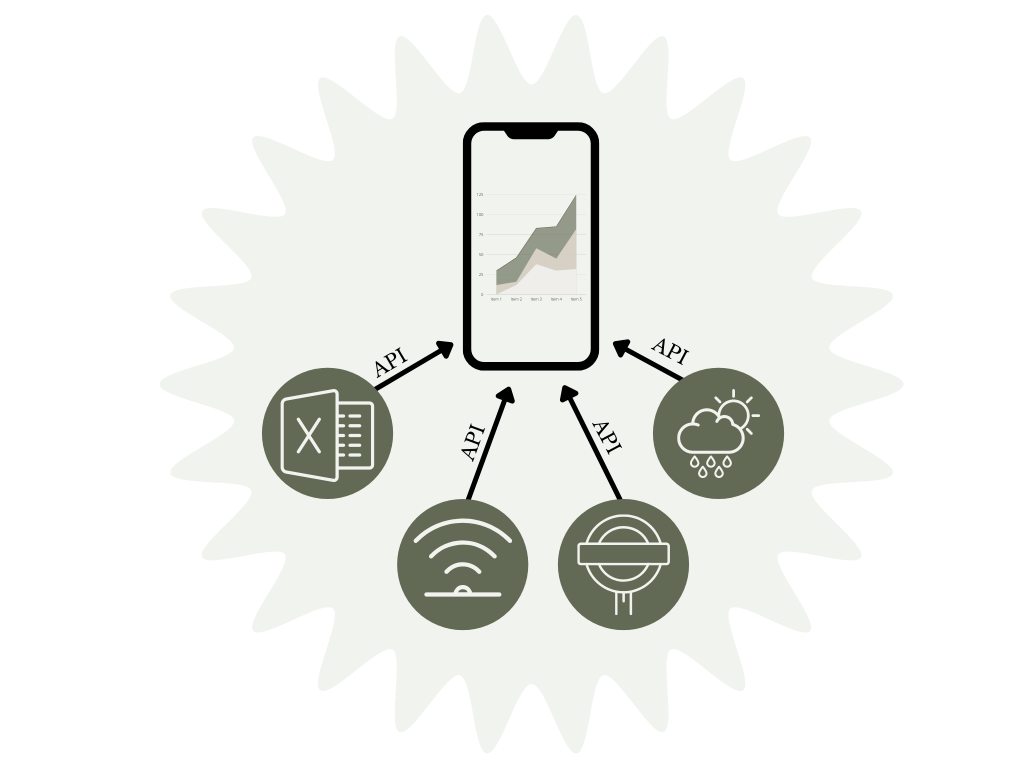
APIs are critical in integrating tech in our lives. Once an API is shared data can flow freely from the source. For example a live tube status widget, is a publicly available API from TfL that anyone can access and add to their website. If I had the tech skills I could add a live tube status widget right here…not that you would come here to find that info…
APIs are a key part of the way we use tech and I couldn’t believe I had no basic knowledge about something I use in literally hundreds of processes every day.
From a property perspective, if someone comes along and shows you how they can pull all sorts of data from multiple sources, be impressed, it is impressive, but don’t be OVER impressed, because, when it comes to data, it’s not what you’ve got, it’s how you use it…
This brings me on to point number 2:
2nd Lesson – Data: It’s not what you’ve got, it’s how you use it
It’s all very well getting the data. But, as above, this is relatively simple if you have the right tech ability.
The key is harnessing data to show us things humans could not have worked out alone. Or would have taken a long, arduous process for us to work out.
In Reeve Wiedeman’s 2020 book about a serviced office business, he discusses some of the non-useful conclusions they reached by installing desk sensors. Wiedeman sums this up with the withering line:
“When I toured a new space in Manhattan, its manager told me that ‘one of our best learnings’ since the space opened was that people liked desks near the windows”
Wiedeman, 2020, p.186
This is an example of complex and expensive tech solutions being mis-used. We instinctively know we are drawn to daylight and views and therefore are more likely to want to sit at a desk near a window. We don’t need data to show us that.
We need to harness data to teach us what we don’t already know.
To do this we need to ask better questions and interrogate the usefulness of the results. If a proptech business shows up at your door offering to show you a whole host of data about your property, you need to ask (both them and yourself):
- Is having this data going to teach me something I don’t already know?
- Or can’t work out via logical observation?
- What is the value of that information?
- Once I have that data, what is the value of the improvements I can make?
- Is this something I need to monitor (and pay for) 24/7?
- Or could I do an audit for a month and know everything I need to know?
- What is the feedback loop?
- How will information be delivered to me?
- How will I make changes based on that information?
Ultimately we are all subject to confirmation bias. We love seeing information that confirms what we already believe but this isn’t the best way to maximise the usefulness of data.
3rd Lesson – Collection & Analysis is Irrelevant without Implementation
Ok so the above shows that the easy bit is collecting the data. The harder bit is analysing the data. But the most important part is actually learning & implementing changes.
At the moment implementation is generally a manual process. For example, let’s take air quality sensors.
If the CO2 levels are too high, the facilities manager will get a notification informing them and they will then make the decision to check the air circulation systems.
The real utility comes when this process can be automated. This can be done by a “Rules Engine”, a piece of software which can be programmed with “If…then…” logic. For example “If a meeting room temperature exceeds 23 degrees then turn on the air conditioning in that room”.
Each time a new scenario is encountered this can be added to the rules engine. The problem again with this process is that it takes a degree of manual input. However, each time the process is done manually once, it can then work by itself indefinitely.
And this is where the real magic begins.
Imagine if every building was producing accurate usage data and expanding its rules engine.
We could continually refine our understanding of how and why buildings work and how to make them better. We would learn things we don’t currently know we don’t know.
This is the mind-blowing opportunity for data in the property world. It’s going to take a while. And will require a certain amount of trial and error.
But eventually, data will enable us to make superior places, in the most appropriate locations, using the least possible energy.
Places that are good for the world, where we actually want to spend our days.

 People | Spaces | Places