(note: this blog has been written with the support of AI, as explored in this blog here)
You may have heard of GANs, or generative adversarial networks. These are artificial intelligence algorithms that can generate new data based on existing data.
An easy way to understand this is to go to the website thispersondoesnotexist.com where you’ll see a face that looks like someone you could walk past on the street. However, these pictures are generated by artificial intelligence. None of the people shown actually exist. Computers have become so advanced at image recognition & reconstruction, they can create new faces from databases of existing real faces and stitch the component parts together (almost always) seamlessly.
GANs have caught my attention as they’ve been popping up all over my LinkedIn Newsfeed as people use them to generate images of themselves as a superhero or in a TV character’s clothes without using any editing software. You simply upload a photograph to a machine learning model (such as Dall-E or Midjourney) and enter prompts to instruct the computer how to edit your photograph.
Naturally, this got me thinking whether we could use the same technology in real estate.
How Could We Use GANs in Real Estate Design?
A GAN could be trained on a dataset of images of houses, and then generate new images of houses that look realistic but don’t actually exist in the real world.
GANs could help in the design process, offering different iterations of design much more quickly and cheaply than is typically available.
Volume of Designs
We could use GANs to generate a greater range of ideas than an architect would feasibly be able to present. Given parameters such as site area and target height, a GAN could come up with a hundred different outline designs for buildings.
The architect and the client could then choose their preferred two or three to take to more detailed design. At the moment we are fairly restricted by time constraints to stick broadly to designs that have been done before. In my experience the architects I know would love to explore many more types of design but are restricted by time to stick to things they feel confident will appeal to the client. Using AI, they could show more “wild cards”.
Outlandish Design
Taking this to the next level, machine learning can be used to come up with outlandish designs and producing a photorealistic version of them close to instantly.
Q//AI has a huge potential in solving the ‘thought-to-execution delay’/
(Manas Bhatia in this great Dezeen article)
Beyond just showing different possible designs for a house, they could help us design in new ways. Here is an amazing example of architect Manas Bhatia doing just that. He prompted a model to produce a building design that showed a blend between architecture and nature.
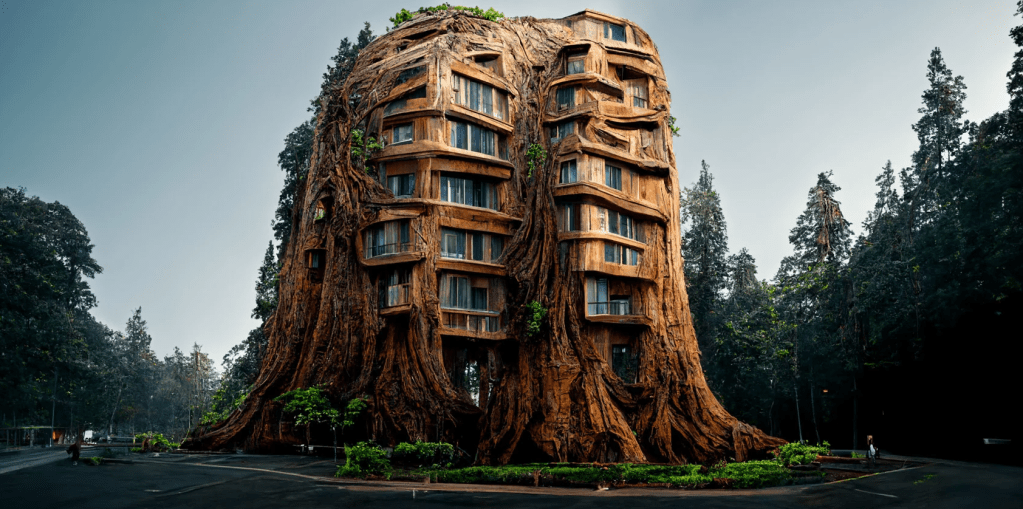
This could lead the way for architects to be bolder in their concepts as they could very quickly test what a seemingly outlandish concept could look like in real life.
Translating into Real Life
At this stage, once a photorealistic building design has been created, the architect would have to go away and work out if it’s actually feasible in our curret world.
The next step will be for the GANs to generate 3D models and floorplan layouts from an initial sketch, but this brings us to the current limitations of GANs. I currently believe that there is not enough consistent data linking photographs of buildings and floorplans but I believe it could come with time.
Limitations of GANs
Currently, if we want better output from computers, we need more data.
There are billions of photographs of houses and flats available on the internet. Therefore a GAN could be trained pretty competently to create a photorealistic image of a house. However, the detailed design of buildings is not commonly available in the same way
Every building built in the UK in the last 50 years or so, should have floorplans registered with the local authority. This could be an amazing source of data to teach computers how to reproduce floorplans. In theory, we could train computers to understand which houses have held their value best, had fewest alterations or repairs. However these are often line drawings focussing most on the layout, without the detail of every single corner of the building.
New Ways to Collect the Data?
Perhaps instead of relying on floorplans, we could use room scanning technology. We could scan rooms in buildings we loved to capture a 3-D model of the interiors of buildings. It wouldn’t take that long (say 100 scans) to start getting enough data that could then be built into an AI model.
We could then use GANs to generate designs for buildings using these examples of formerly successful buildings. We could also show scans of buildings we don’t like so much and train the models to avoid designs like this!

 People | Spaces | Places
1 Comment