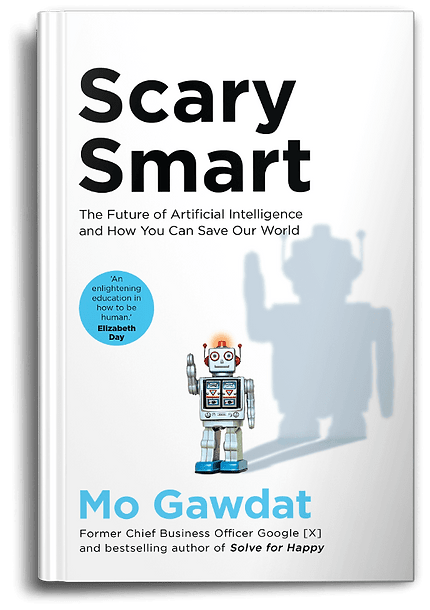
Scary Smart: The Future of Artificial Intelligence and How You Can Save Our World
By Mo Gawdat
Who is Mo Gawdat and what authority does he have to write about AI?
Lots of authority in my book!
Gawdat was formerly the Chief Business Officer at Google X the part of google they call “The Moonshot Factory” i.e. the one that takes “crazy” big ideas and tries to turn them into reality.
Therefore he has seen the development of AI first-hand from one of the best sources.
Gawdat is also an author and a philosopher (by my definition). He’s a deep thinker whose previous book focused on happiness. Therefore he is in a great position to explore AI and how it relates to our human future.
Gawdat’s “Scary” Inspiration
Gawdat became nervous about AI when observing one of Google’s experiments with robotics.
A team in his office had set up a number of robotic arms, each sitting in a tray with children’s toys in it. The robots were set to attempt to pick up the toys and record the exact pattern of every movement they made. The robots could then keep learning from this data with the aim of ultimately learning how to grip objects successfully.
Gawdat walked past these robotic arms every day for weeks whilst they made haphazard attempts to pick up the toys.
Initially, it seemed to Gawdat like a fun and flippant experiment.
However once the first robot picked up the first toy successfully, the speed of improvement accelerated until all of the arms were about to pick up every single toy, every single time.
This happens because once one robot has found a successful pattern, it shares it instantly with the remaining 10 robots.
It was at this point that he started to consider the potential of this technology “scary” and thus his desire to share more about its real impacts began.

Some of Scary Smart’s Key Themes:
Utopia or Dystopia: It’s in our hands
Gawdat believes that AI will go one way or another. It will create a dystopia or utopia. The power of AI means there’s not much space for anything in between.
The main message for me from this book was for me to understand that whichever it ends up being, is in our control.
Ultimately, it’s not up to companies building AI and it’s not up to our governments.
We, the people, are the main contributors to the internet. This means that the AI learns from us.
Therefore, if we want a world where AI is a force for good, we can make it happen.
This is intimidating but also encouraging. It makes me feel empowered. We are not (completely) at the whim of the tech companies, we have some influence ourselves.
Corporations vs Contributors
The future of AI is not really in the control of the corporations.
Whether it’s their responsibility or not is subject of fierce debate. I won’t address here whether or not the corporations should take more responsibility.
They are certainly responsible for shaping the way algorithms share content which can make “clickbait” type headlines be shared much more quickly and led to more polarised thinking.
However that point aside, the corporations create the infrastructure.
That infrastructure allows us to create the content.
AI learns from the content it can read on the internet.
Therefore the humans who put the content on the internet are teaching the artificial intelligence.
Watch What You Share
AI is learning how humans interact by observing behaviours on social media platforms. Therefore it is primarily in our control to show them how well humans can behave.
Why is AI learning from social media?
AI (currently) requires vast amounts of data to learn quickly and deeply.
Gawdat points out:
Q// Every year we create more content on the internet than all of the knowledge created since the dawn of humanity.//
(Gawdat, Scary Smart 2021)
Social media is the perfect data source for AI to refine its knowledge.
Every word we type and make publicly available will be absorbed by AI and used to make conclusions and projections on the future.
AI will learn every time someone makes an aggressive and snarky comment on a video that humans speak to each other in this way.
Equally, AI will learn every time a person shares a thoughtful and nuanced opinion.
It is up to us to do more of the latter and less of the former.
Teaching the AI Pro-Human Values
Gawdat believes that we need to believe that AI are like our children.
They learn from us, they copy our behaviours and create their own actions based on the examples they’ve been set.
He uses some great examples of cultural shaping.
For example, he speaks about his Indian-born colleagues in Silicon Valley, many of whom returned to India when their parents got to an age where they needed support. In many countries, there is an understanding that when people get old, they will be looked after by their children and wider families.
In contrast, in the UK, there is (generally) less expectation that families will look after their elders. This leads to many older people ending up in care homes and nursing homes.
These two different ways of thinking have emerged in human culture over time.
Gawdat makes the rather chilling point that if we follow the UK model when it comes to AI then almost certainly the AI will just do whatever is best for it to achieve its goals and will leave us humans to rot in the proverbial care home.
Q//We need to raise our artificially intelligent infants in a way that is different to our usual Western approach. Rather than just teaching them skills, intelligence and how to achieve targets, can we also raise them to be loving, caring kids? We most definitely can, but for that to happen, you – yes, you – will have a big role to play.//
(Gawdat, Scary Smart, 2021, p.192)
In the same vein, think about how you speak to your Alexa or your Google Home. Every time you speak to it you are helping it to learn and improve its responses
Therefore if all it hears is “hey google, play fart noises” you can understand how it (fairly) would start to believe in the simplicity of human humour.
If you fancy delving deeper, buy the book here. It may indeed scare you at times but ultimately you will be left feeling hopeful and empowered to improve the future of AI yourself.
Book Review FAQs
Who is this book for?
Anyone interested in the wider social implications of AI.
Do I need prior AI knowledge?
Nope! It’s a big-picture discussion. A great way to start understanding AI.
Will this cause me to have an existential crisis?
Errr I won’t lie, some of the concepts in this book are intimidating, hence the title “Scary” Smart. However, ultimately it is an optimistic look at what we, as individuals, can do to make AI a force for good.
Audio or book?
I love Mo Gawdat’s voice but I found some concepts in this book hard to absorb over audio. Therefore, I would personally recommend reading the book.

 People | Spaces | Places