When computer scientists started thinking about creating artificial intelligence, the most obvious thing was to examine human intelligence and recreate it.
However, as we don’t truly understand how the human brain works we can’t precisely recreate it. But many smart people are working their way there.
To do this they’ve started to imitate what we do know about how the brain works, through a thing called a Neural Network.
Once a Neural Network is in place, a computer can start a process called “Deep Learning” which gets us increasingly close to learning the way a human would…
Neural Networks
Remember diagrams like this from school? This is the nerve cell or neuron or simply a “Brain Cell”. Every single thought and feeling we have is simply due to electrical impulses moving from neuron to neuron.

Each neuron is connected to between 10 to 100,000 other neurons (Russell & Norvig 2016 p.11) creating a web where information darts about, all day, every day, below our level of conscious thought.
Despite being below our consciousness, this process is how we think, feel and know anything and everything in our lives.
Computer scientists replicated these neurons and, inventively, have called them “Artificial Neurons”.
Artificial Neurons
Computer scientists aim to copy the behaviours of the neurons in our brains in order to create computer intelligence.
So far, so obvious.
To do this, a single artificial neuron is trained to answer a question which, alone, is straightforward.
For example to answer the question “Should I buy this top?” we can split that decision into three questions:
- Do I like it?
- Do I need it?
- Can I afford it?
The diagram below shows the decision making process for each of these questions.
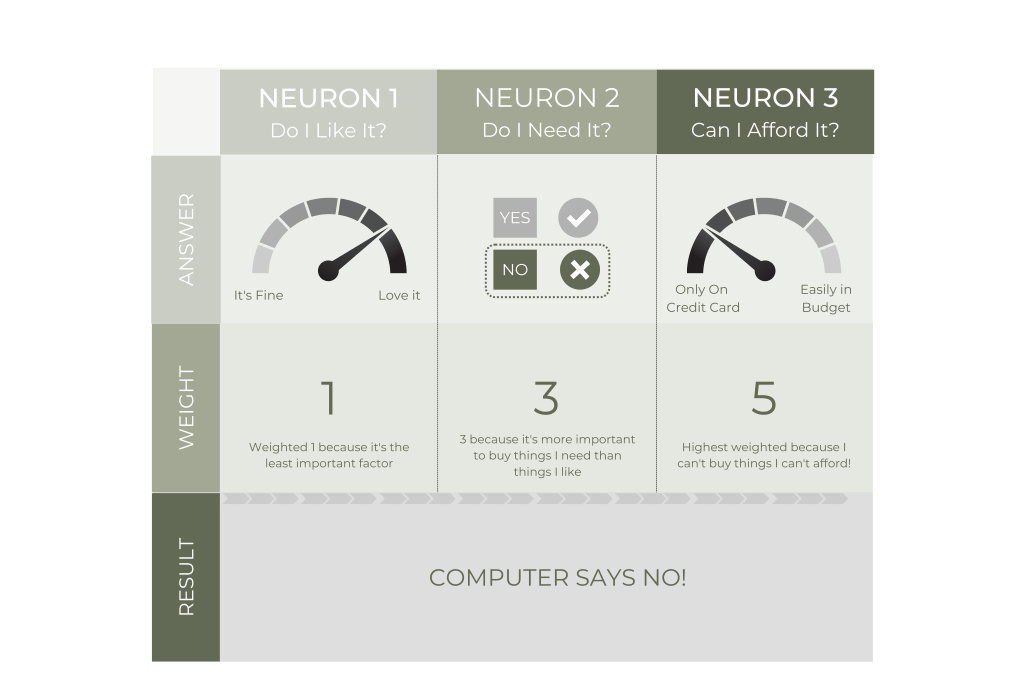
We feel like there’s thousands of different factors at play in decision making but normally we can split these into a few key questions. It’s just like those decision trees in your favourite teen mags, back in the day.
The questions can be answered with a “Yes” or “No” or on a scale.
Each answer is then “Weighted”. This reflects which question is most important. In this case it’s “Can I afford it?”. Even if you love something with all your heart, if you can’t afford it, that will (or should!) outweigh how much you like it.
Artificial Neural Networks
In the example above, the three neurons are connected together to make the decision. This is the artificial neural network and replicates the way the human neurons work together to process information.
Once a computer has been programmed with the different questions (or “neurons”), they can start processing information and making decisions.
As more neurons or “questions” are added, the network can contemplate increasingly complex scenarios.
In the above example we could add many more questions, each creating a more thoughtful response.
For example:
- Is the T-Shirt sustainably sourced?
- Do any of my friends already have it?
- Do I expect the price to go up in the future?
- How expensive is delivery?
Limitations of Artificial Neural Networks
If we stay with the analogy that an Artificial Neuron is like a brain cell, then the argument follows that if we create a big enough Artifical Neural Network we can recreate a human brain. Simples!
But not so fast…
The average human brain contains 85 billion brain cells.
It’s an inconceivable job for any human computer engineer to model 85 billion artificial neurons coherently.
If we want to create human-level intelligence, we will need to create artifical neurons that can start programming themselves, so they’re not limited by the capacities of human engineers.
This is where Deep Learning comes in and we’ll come on to that next time.

 People | Spaces | Places
2 Comments